 MepcoOnlineBill
What is a MEPCO Bill?
Your monthly electricity bill from Multan Electric Power Company covers all 13 districts of South Punjab. It shows exactly how many units you consumed, what you owe, and the due date by which you must pay to avoid a late payment surcharge.
Multan Electric Power Company (MEPCO) is the largest electricity distribution company in Pakistan by geographic coverage, serving over 8.9 million registered connections across Multan, Bahawalpur, Dera Ghazi Khan, Sahiwal, Rahim Yar Khan, Khanewal, Vehari, Muzaffargarh, Lodhran, Layyah, Rajanpur, Pakpattan, and Bahawalnagar. If your address is in South Punjab, your bijli bill comes from this company — and this site helps you check, download, and understand it.
Where to Find Reference Number & Consumer ID?
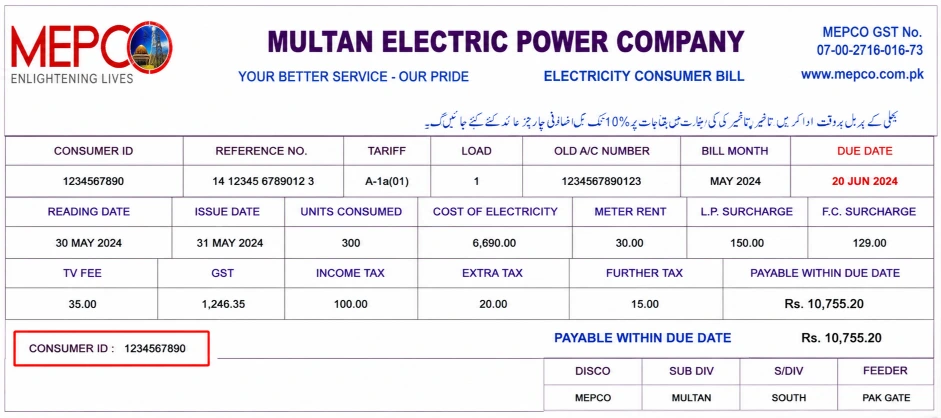
Before you check your bill online, you will need your 14-digit reference number or 10-digit consumer ID. You can easily find both on any of your previous printed MEPCO bills, as shown in the image below:
How to Check MEPCO Bill Online in 2026
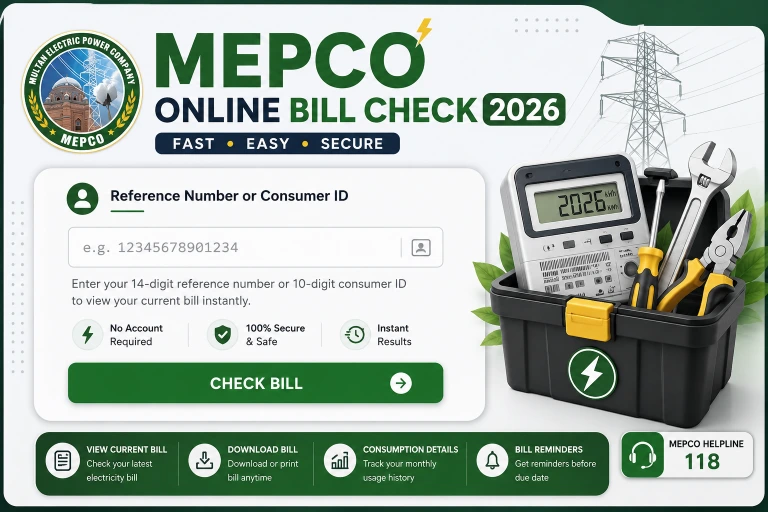
You do not need to wait for the paper bill to arrive. Checking your electricity bill online takes less than 30 seconds:
- Find your 14-digit reference number on any previous bill — printed at the top left (highlighted in red box).
- Enter it in the bill checker tool above and press Check Bill.
- Your latest bill opens instantly with amount payable, due date, electricity usage, and issue date.
- Download it as a PDF or print a duplicate copy.
If you do not have your reference number, use your 10-digit consumer ID instead — also printed on the left side of any old bill. Both work on the official PITC billing portal that powers this tool.
- Payable amount before and after due date
- Meter reading date and monthly consumption
- 12-month bill history
- FPA, GST, FC Surcharge, and other charges breakdown
- Connection details and billing address
3 Ways to Check Your Electricity Bill — Online, SMS, and App
1. Online Bill Check (Fastest)
Use the tool at the top of this page. Enter your 14-digit reference number and your bill appears in seconds. You can view, download, or print it directly — works on any phone, tablet, or computer, no login required, completely free.
2. Check by SMS (No Internet Needed)
If you are in an area with weak internet or do not have mobile data, the SMS service lets you check from any SIM — Jazz, Zong, Telenor, or Ufone:
- Type: your 14-digit reference number
- Send to: 8119
Standard SMS charges apply. This is the most reliable option for households in rural areas of South Punjab where internet connectivity can be inconsistent.
3. Mobile App
No official standalone app exists on Google Play. Any app claiming to be the "official MEPCO app" is third-party — use it with caution. The safest and fastest method remains checking through the PITC web portal (which this site links to directly) or via SMS to 8119.
What Every Charge on Your Electricity Bill Means
This is the part most people skip, and then wonder why their amount is higher than expected. Here is every line item on a standard South Punjab residential bill, explained plainly:
| Charge | What it is |
|---|---|
| Energy charges | The base cost of electricity calculated by tariff slab |
| Fuel Price Adjustment (FPA) | Monthly charge reflecting real fuel cost vs. NEPRA's reference price — changes every month |
| General Sales Tax (GST) | 18% government tax on the total — exempt for lifeline households (under 50 units) |
| FC Surcharge | Financing Cost Surcharge — covers power sector debt financing costs |
| Quarterly Tariff Adjustment (QTA) | Applied every three months for distribution margin and capacity changes |
| Electricity Duty | Provincial government tax — approximately 1.5% of energy charges |
| Fixed charges / Meter rent | Rs. 75/month for single-phase, Rs. 150/month for three-phase — charged even at zero electricity usage |
| NJ Surcharge | Neelum-Jhelum Hydropower Project surcharge — goes toward the project's financing |
| TV fee | PTV license fee — abolished by the government in July 2025. Current bills should show zero. |
| Arrears | Any unpaid amount from previous months carried forward |
The honest number: For most unprotected households in South Punjab, these taxes and surcharges add 40 to 50 percent on top of the base energy charge. A Rs. 6,000 energy charge can become a Rs. 9,000 total after GST, FPA, and surcharges. These are government-mandated charges — not errors in the bill.
MEPCO Tariff Slabs 2026 — What You Pay Per Unit
NEPRA (National Electric Power Regulatory Authority) sets electricity rates for all distribution companies through S.R.O. No. 279(I)/2026. The rates below are for domestic residential connections (Tariff A-1):
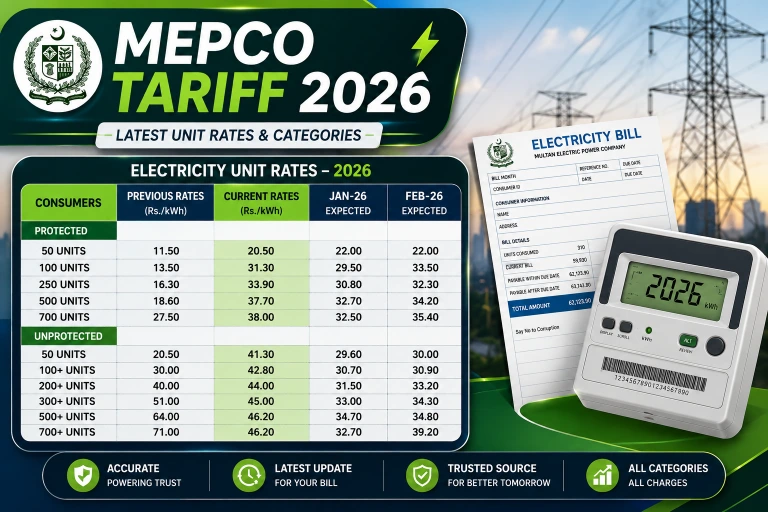
Protected Consumers
(average consumption 200 kWh or less over 6 months)
| Monthly consumption (kWh) | Rate per kWh (PKR) |
|---|---|
| 1 – 50 | Rs. 5.00 |
| 51 – 100 | Rs. 7.77 |
| 101 – 200 | Rs. 14.00 |
Minimum fixed charge: Rs. 75/month (single-phase) even at zero consumption.
Unprotected Consumers
(over 200 kWh in any month)
| Monthly consumption (kWh) | Rate per kWh (PKR) |
|---|---|
| 1 – 100 | Rs. 22.00 |
| 101 – 200 | Rs. 27.00 |
| 201 – 300 | Rs. 36.00 |
| 301 – 700 | Rs. 45.00 |
| Above 700 | Rs. 68.00 |
The 200-unit trap: The moment your consumption crosses 200 units in a billing month, the company removes your protected status for that cycle and bills all your electricity usage at the higher unprotected rates — from unit 1 onwards, not just the excess. A household using 195 units pays under Rs. 2,500 in energy charges. The same household at 205 units pays over Rs. 5,000. This is not an error. It is how the slab system works. Use our bill calculator to see exactly where you stand before month-end.
These tariff rates do not include FPA, GST, surcharges, or fixed charges. Your final payable amount is always higher than what the slab rates alone suggest.
What is FPA and Why Does Your Electricity Bill Change Every Month?
You may have noticed your bill changes even in months where your usage did not change. The reason is the Fuel Price Adjustment (FPA).
Multan Electric Power Company does not generate electricity — it buys power from WAPDA Hydel, HUBCO, KAPCO, and independent power producers (IPPs). These plants run on furnace oil, LNG, coal, and hydro. Their fuel costs fluctuate with global oil prices and the PKR-USD exchange rate. NEPRA calculates the difference between actual fuel costs and the reference price built into your tariff, then passes that difference to you as FPA — positive or negative, every month.
In January 2026, NEPRA approved Rs. 1.63 per unit as FPA. For a household using 300 units that month, that was Rs. 489 extra — added purely from fuel costs, with no change in electricity usage.
Summer months are the worst combination: you consume more electricity because of ACs and coolers, AND FPA tends to be higher before the monsoon because dam levels are low, forcing more thermal generation. Both forces hit your amount simultaneously.
You cannot control FPA. But since it is charged per unit, the less electricity you use, the less FPA you pay. This is why staying below 200 units matters more than most people realize.
Protected vs Unprotected — What Is the Difference?
This is one of the most searched questions about electricity billing in South Punjab, and for good reason — the difference in your monthly amount is massive.
- Protected status: If your average electricity consumption over the past 6 consecutive billing months has been 200 kWh or less, you are classified as a protected consumer. You get subsidized government tariff rates (as low as Rs. 5 per kWh on the first 50). The federal government makes up the difference through subsidy.
- Unprotected status: If your monthly consumption exceeds 200 kWh in any single billing cycle, you move to the unprotected category — not just for that month, but for the next 6 months. During this period, you pay the higher unprotected tariff regardless of how little electricity you actually use in those months.
- Lifeline status: A sub-category for households drawing 50 kWh or less monthly. They pay the lowest rates and are exempt from GST — primarily covers very low-income rural households in South Punjab.
If you are close to the 200-unit boundary, check your meter reading in the last week of your billing cycle. Shifting heavy appliance use — AC, iron, washing machine, water motor — to off-peak hours can keep you just under the limit and save thousands of rupees every month.
Common Electricity Bill Problems and What to Do
Living in South Punjab, you know the monthly electricity bill brings its own headaches. Here are the most common ones:
Bill arrives late or not at all
This is extremely common, especially in villages, rental properties, and new housing schemes. The landlord may hold the paper bill, or it simply does not get delivered on time. The solution is to check online — use this site any time after your meter reading date. Bills are usually available online 2 to 3 days after the reading.
Bill shows "EST" next to the reading
EST means estimated — the meter reader did not physically visit your premises that month and your electricity usage was estimated based on past consumption. Estimated readings frequently run higher than actual usage. Photograph your meter every month. If the estimated amount looks wrong, file a bill correction complaint. The next actual reading will reconcile the difference.
Bill amount is suddenly very high
Three most common reasons: (1) Your monthly consumption crossed 200 kWh and you lost protected status — all electricity usage is now billed at unprotected rates. (2) FPA was higher this month due to more thermal generation. (3) An estimated reading was issued that is higher than your actual usage. Check the breakdown line by line, or use the bill calculator to verify whether the amount looks right for your consumption.
Bill not found online
If you enter your reference number and nothing appears, wait 2 to 3 days — the bill may not have been generated yet. If the system shows "not found," double-check your 14-digit number from a previous printed bill. If the problem persists, visit your nearest subdivision office.
Wrong name or address on bill
Name and address corrections require a visit to your local subdivision office with CNIC, property documents, and the latest printed bill. The process typically takes 7 to 15 working days.
Detection bill received
A detection bill is a penalty charge issued when meter tampering, electricity theft, or unauthorized load extension is found. It is not your regular monthly bill. It is calculated under Sections 39 and 39-A of the Electricity Act 1910 and carries serious legal consequences if ignored.
How to Pay MEPCO Bill Online in 2026
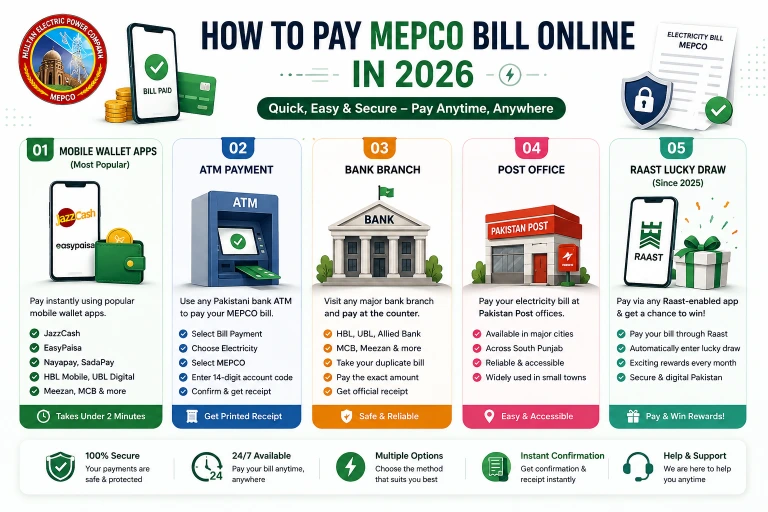
You do not need to visit a bank or stand in a queue. Your electricity bill can be paid through multiple digital channels:
- Mobile wallet apps (most popular in South Punjab):
- JazzCash — Open app → Bill Payment → Electricity → MEPCO → enter your number → pay
- EasyPaisa — Same process, takes under 2 minutes
- Nayapay, SadaPay, HBL Mobile, UBL Digital, Meezan, MCB — all support electricity bill payment under utility bills
- ATM payment: Any Pakistani bank ATM — select Bill Payment → Electricity → MEPCO → enter your 14-digit account code → confirm. You receive a printed receipt as proof.
- Bank branch: HBL, UBL, Allied Bank, MCB, Meezan, and most major banks accept bill payments at the counter. Take your printed or downloaded duplicate bill and the payable amount.
- Post office: Pakistan Post offices in major cities across the South Punjab service area accept electricity bill payments. Still widely used in smaller towns.
- Raast lucky draw: Since 2025, the company has partnered with Raast for a lucky draw scheme. Pay your bill via any Raast-enabled app and you are automatically entered.
Pay before the due date. Late payment adds a surcharge — typically 10% of the payable amount. Even a one-day delay after the due date means you pay the late payment surcharge in full.
Service Areas — All 13 Districts of South Punjab
The company provides electricity to all of South Punjab. If your address is in any of these 13 districts, your bijli bill comes from here:
Multan (headquarters) · Bahawalpur · Dera Ghazi Khan · Sahiwal · Rahim Yar Khan · Khanewal · Vehari · Muzaffargarh · Lodhran · Layyah · Rajanpur · Pakpattan · Bahawalnagar
The distribution network runs through 9 circles, 38 divisions, and 181 subdivisions covering approximately 97,000 to 106,000 sq km — with over 82,000 km of distribution lines, 786 grid stations, and 672 feeders.
Many households in South Punjab still call it the "WAPDA bill." Technically, Multan Electric Power Company is a separate entity from WAPDA — incorporated in May 1998, it now operates independently under the Ministry of Energy (Power Division). The name printed on your bill is MEPCO.
Check your city-specific bill and office information:
Bill check — Multan · Bill check — Bahawalpur · Bill check — DG Khan · Bill check — Sahiwal · Bill check — Rahim Yar Khan · Bill check — Khanewal · Bill check — Vehari · Bill check — Muzaffargarh · Bill check — Lodhran · Bill check — Layyah · Bill check — Rajanpur · Bill check — Pakpattan · Bill check — Bahawalnagar
Helpline and Contact Numbers 2026
For billing complaints, meter issues, load shedding information, or emergencies:
| Purpose | Number |
|---|---|
| General helpline (24/7) | 118 |
| Complaint SMS | 8118 |
| Toll-free customer line | 0800-63726 |
| Bill check via SMS | 8119 (send your 14-digit code) |
| Head Office Multan | 061-9220198 |
Circle-wise contact numbers:
- Multan: 061-9220198
- Bahawalpur: 062-9250102
- Rahim Yar Khan: 068-9230160
- DG Khan: 064-9239229
- Sahiwal: 040-9200305
- Muzaffargarh: 066-9200065
- Vehari: 067-3360282
- Bahawalnagar: 063-9239031
For online complaint registration and tracking, use the PITC CCMS portal at ccms.pitc.com.pk — create a free account, enter your consumer ID, and submit your complaint in under 5 minutes.
Quick Links — All Tools and Guides
- MEPCO Bill Calculator 2026 — Estimate your bill before it arrives, with full slab and tax breakdown
- Download Duplicate Bill — Print or save a PDF copy of your latest bill
- Bill History — Last 12 Months — View and download all previous bills
- What is FPA? — Why your electricity bill changes every month even when usage stays the same
- Tariff Rates 2026 — Full slab rates for domestic, commercial, industrial, and agricultural connections
- File a Bill Complaint — How to register, track, and follow up on billing complaints
- Detection Bill Explained — What triggers one, how it is calculated, and your rights
- Load Shedding Schedule — Current schedule by feeder and area
- Net Metering 2026 — How the December 2025 net billing policy change affects solar users
- New Connection Guide — Step-by-step application, documents needed, and demand notice tracking
Frequently Asked Questions
About This Site
This site is run by John Doe, an SEO professional and digital content researcher focused on Pakistani utility information. The goal is to give electricity consumers across South Punjab accurate, plain-language information about their bills — without outdated numbers or fluff that fills most bill-check websites.
All tariff figures here are sourced from NEPRA official notifications and verified against the PITC billing portal. Whenever NEPRA revises rates or the company announces a policy change, this site is updated within 48 hours.